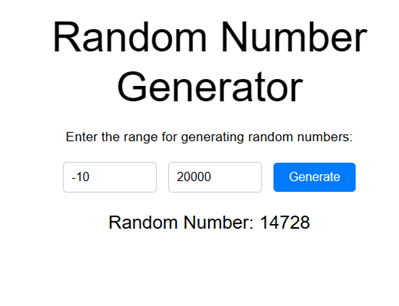
Random Number Generator
Enter the range for generating random numbers:
Free Online Random Number Generator
DigiSadhan’s Random Number Generator is a free online tool that allows users to generate random numbers within a selected minimum and maximum range. It is useful for games, classroom activities, probability experiments, random selections, contests, testing, programming practice and everyday decision-making.
Simply enter the minimum number and maximum number, generate the required result, and get a random number instantly.
A uniformly distributed integer generator gives each possible integer in the specified inclusive range an equal probability of being selected.
What is a Random Number Generator?
A Random Number Generator (RNG) is a tool or algorithm used to produce numbers that appear unpredictable.
For example, if the selected range is:
1 to 100
the generator can produce any integer from:
1, 2, 3, … 98, 99, 100
When the generator uses a uniform distribution, each number has the same probability of being selected.
Random numbers can be useful for:
- Games
- Lucky draws
- Contests
- Classroom activities
- Mathematics practice
- Probability experiments
- Random sampling
- Software testing
- Programming
- Simulations
- Decision-making
How to Use DigiSadhan Random Number Generator?
Using the online tool is simple.
Step 1: Enter Minimum Number
Enter the smallest number allowed.
For example:
1
Step 2: Enter Maximum Number
Enter the largest number allowed.
For example:
100
Step 3: Generate the Number
Click the Generate button.
Step 4: View the Result
The calculator produces a random number within the selected range.
You can repeat the process whenever another random number is required.
Random Number Calculation Formula
For an integer between Minimum (Min) and Maximum (Max), inclusive, a common uniform-generation formula is:
Random Number = Min + floor[R × (Max − Min + 1)]
Where:
- Min = minimum value
- Max = maximum value
- R = random value between 0 and 1
- floor = largest integer less than or equal to the calculated value
This mapping produces an integer from Min through Max when the underlying random value is uniformly distributed.
Random Number Calculation Example
Suppose:
Minimum = 1
Maximum = 100
and the random value generated is:
R = 0.37
First calculate the number of possible integers:
100 − 1 + 1 = 100
Now:
Random Number = 1 + floor(0.37 × 100)
= 1 + floor(37)
= 38
Therefore, the generated random number is:
38
This is an example of the calculation process; an actual generator will use a new random value each time.
Probability of a Random Number
If there are N equally likely integers, the probability of selecting any particular number is:
P(Number) = 1 ÷ N
The number of possible integers between Min and Max, inclusive, is:
N = Max − Min + 1
Therefore:
P(Number) = 1 ÷ (Max − Min + 1)
Example: 1 to 10
There are:
10 − 1 + 1 = 10 numbers
The probability of generating any particular number, such as 7, is:
1 ÷ 10 = 0.10
or:
10%
Thus, each individual number from 1 through 10 has a 10% probability in a uniform single draw. Integer distributions are commonly used to model equally likely discrete outcomes.
Multiple Random Numbers
If you generate several random numbers, the generator repeats the random-selection process.
For example, selecting five numbers from 1 to 100 could produce:
17, 83, 42, 6, 91
Another generation may produce a completely different sequence.
If duplicates are allowed, the same number can appear more than once:
17, 42, 17, 91, 42
If unique numbers are required, each selected number must be removed from the available pool before the next selection.
Random Number Generator with No Repetition
Suppose you need 3 unique numbers between 1 and 10.
The available numbers initially are:
1, 2, 3, 4, 5, 6, 7, 8, 9, 10
If the generator selects:
4
remove 4.
Next it may select:
8
remove 8.
Then:
2
The final result is:
4, 8, 2
No number is repeated.
This type of selection is useful for raffles, classroom assignments, team selection and randomized lists.
Random Number Generator for Games
A random number generator can simulate simple game outcomes.
For example, to simulate a six-sided die:
Minimum = 1
Maximum = 6
Possible results:
1, 2, 3, 4, 5, 6
The probability of each result is:
1 ÷ 6 ≈ 16.67%
This is an example of a discrete uniform distribution.
Random Decimal Number Formula
For a random decimal value between two boundaries, a common transformation is:
X = Min + R × (Max − Min)
where R is a uniformly distributed value from 0 up to, but not including, 1.
For example, if:
Min = 10
Max = 20
and:
R = 0.50
then:
X = 10 + 0.50 × (20 − 10)
= 10 + 5
= 15
This is the standard transformation from a uniform 0–1 random variable to another interval.
Random Number Generator Uses
DigiSadhan’s Random Number Generator can be useful for:
Education
Teachers can randomly select students, questions or activities.
Games
Generate numbers for dice-style games, puzzles and challenges.
Lucky Draws
Select random numbers for informal draws and contests.
Mathematics
Practice probability, statistics and random sampling.
Programming
Test applications using different numerical inputs.
Simulations
Generate random values for simple mathematical and statistical experiments.
Decision Making
Use random numbers when choosing between several equivalent options.
Random vs Pseudo-Random Numbers
Computer programs commonly generate pseudo-random numbers using algorithms. These numbers appear random but are generated deterministically from an internal state or seed.
For ordinary games, educational activities and general random selection, a standard pseudo-random generator can be appropriate.
However, a general-purpose random number generator should not automatically be treated as suitable for cryptographic security. Security-sensitive applications require a cryptographically secure random-number source.
For example, JavaScript’s Math.random() is intended for non-security-sensitive uses; MDN specifically warns that it is not suitable for cryptographic applications.
Benefits of DigiSadhan Random Number Generator
- Free online random number generator
- Generate numbers within a selected range
- Simple minimum and maximum inputs
- Instant results
- Useful for games
- Helpful for students and teachers
- Useful for probability practice
- Random selection for activities
- Programming and testing applications
- Mobile-friendly
- Easy to use
Frequently Asked Questions
What is a Random Number Generator?
A Random Number Generator is a tool or algorithm that produces numbers according to a specified randomization process.
Can I generate a random number between two numbers?
Yes. Enter the minimum and maximum values and generate a number within the selected range.
Are the minimum and maximum values included?
For an inclusive integer range, both the minimum and maximum values can be generated. This is a common convention for integer random-number functions.
What is the formula for a random integer?
A common formula is:
Random Number = Min + floor[R × (Max − Min + 1)]
What is the probability of each number?
For a uniform range, if there are N possible integers:
Probability = 1/N
Can I generate multiple random numbers?
Yes. Multiple selections can be generated by repeating the random-selection process.
Can random numbers repeat?
That depends on the generator’s selection method. With replacement, duplicates can occur. Without replacement, generated values remain unique.
Is a Random Number Generator truly random?
Software generators are commonly pseudo-random. They use algorithms to produce sequences that have random-like statistical properties. Special hardware or cryptographic systems may use stronger sources of randomness.
Is DigiSadhan’s Random Number Generator free?
Yes. DigiSadhan provides this random-number tool as a free online utility.
रैंडम नंबर जनरेटर – हिंदी में
मुफ्त Online Random Number Generator
DigiSadhan का Random Number Generator एक मुफ्त ऑनलाइन टूल है जिसकी सहायता से आप अपनी पसंद की Minimum और Maximum Range के बीच Random Number Generate कर सकते हैं।
उदाहरण:
यदि Range है:
1 से 100
तो Generator इनमें से कोई भी Number दे सकता है:
1, 2, 3, … 98, 99, 100
Uniform Random Selection में सभी संभावित Numbers की Probability समान होती है।
Random Number Generator कैसे इस्तेमाल करें?
- Minimum Number दर्ज करें।
- Maximum Number दर्ज करें।
- Generate बटन पर क्लिक करें।
- Random Number प्राप्त करें।
- आवश्यकता होने पर दोबारा Generate करें।
Random Number का Formula
Integer Random Number के लिए:
Random Number = Min + floor[R × (Max − Min + 1)]
जहाँ:
- Min = Minimum Number
- Max = Maximum Number
- R = 0 और 1 के बीच Random Value
- floor = नीचे की ओर पूर्णांक लेना
उदाहरण:
Min = 1
Max = 100
R = 0.37
तो:
1 + floor(0.37 × 100)
= 1 + 37
= 38
इसलिए Random Number:
38
Probability की Calculation
यदि Range में कुल N Numbers हैं:
Probability = 1 ÷ N
उदाहरण:
1 से 10 तक:
N = 10 − 1 + 1 = 10
किसी एक Number की Probability:
1 ÷ 10 = 10%
अर्थात 1 से 10 तक प्रत्येक Number की समान Probability 10% है, यदि selection uniform है।
Multiple Random Numbers
यदि आपको 5 Random Numbers चाहिए, तो उदाहरण के लिए Result हो सकता है:
17, 83, 42, 6, 91
यदि duplicates allowed हैं, तो:
17, 42, 17, 91, 42
भी संभव है।
यदि Unique Numbers चाहिए, तो चुने गए Number को अगली selection से हटाया जाता है।
Dice के लिए Random Number
6-sided dice को simulate करने के लिए:
Minimum = 1
Maximum = 6
Possible Results:
1, 2, 3, 4, 5, 6
हर Number की Probability:
1 ÷ 6 × 100 ≈ 16.67%
Random Decimal Number का Formula
Decimal Random Number के लिए:
X = Min + R × (Max − Min)
उदाहरण:
Min = 10
Max = 20
R = 0.50
तो:
X = 10 + 0.50 × (20 − 10)
= 15
Uniform random variable को किसी दूसरे interval में बदलने के लिए इस प्रकार का transformation commonly used है।
Random Number Generator के उपयोग
- Online Games
- Lucky Draw
- Contest
- Classroom Activities
- Student Selection
- Mathematics Practice
- Probability Experiments
- Statistics
- Programming Testing
- Random Sampling
- Decision Making
- Simulations
Random और Pseudo-Random Numbers
Computer software में अक्सर Pseudo-Random Numbers generate किए जाते हैं। ये numbers algorithm के माध्यम से बनते हैं और random जैसे दिखाई देते हैं।
Games, education और सामान्य random selection के लिए ऐसे generators उपयोगी हो सकते हैं।
लेकिन password generation, encryption keys या अन्य security-sensitive कामों के लिए सामान्य random generator पर निर्भर नहीं करना चाहिए। उदाहरण के लिए, MDN के अनुसार JavaScript Math.random() cryptographic applications के लिए उपयुक्त नहीं है।
DigiSadhan Random Number Generator के फायदे
- Free Online Tool
- Minimum और Maximum Range
- Instant Random Number
- Multiple Number Generation
- Games के लिए उपयोगी
- Students के लिए उपयोगी
- Probability Learning
- Lucky Draw के लिए उपयोगी
- Programming Testing
- Mobile-Friendly
- आसान Interface
Example: